The Durand Line: The Impact of a Contentious Border
- 21 September 2026
- Author Saadat Mousavi
Pakistan has been busy for the last nine years fencing off the 2,640-kilometre Durand Line with Afghanistan, creating a barrier that runs right through the heart of Pashtunistan, the homelands of the Pashtun people. How does this controversial border fence shape the lives of the people living on both sides?
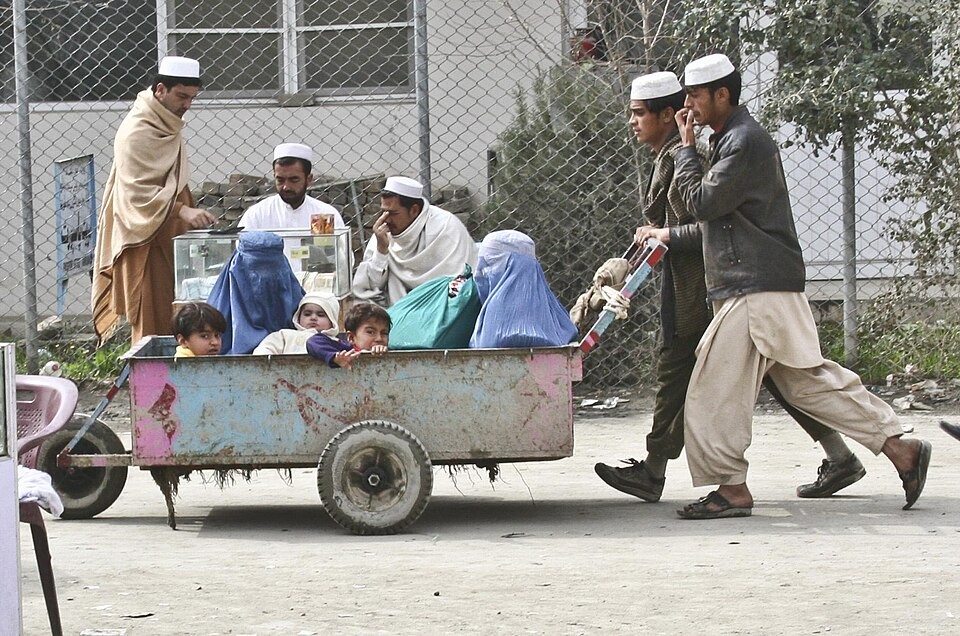
Some boys push a cart with a family in it down the pedestrian walkway at Torkham Gate on the Afghanistan/Pakistan border, Afghan side, 7 March 2011.
Staff Sgt. Ryan Matson, Public domain, via Wikimedia CommonsThe Durand Line between Pakistan and Afghanistan is one of the most controversial borders in the world. Beginning in 2017, it was subject to the latest outcry when the Pakistani government began fencing it off. The new 2,600-kilometre fence cut through the agricultural lands, orchards, and villages of the Pashtun-majority borderlands. When Pakistani security forces reached the village of Kharsin in eastern Afghanistan’s Paktika province, the barrier they erected ran right through the middle of the village.
The communities inhabiting this land have lived for centuries under a self-governing system based on tribal structures and local norms. The Pashtun ethical code of Pashtunwali formed the basis of how people lived together. No one cared if they were Pakistani or Afghan on paper. With the imposition of the fence, villages were split; land and settlements were divided. But more importantly still, historical, tribal, and familial ties that had formed over centuries on both sides of the line, were severed.
This article is not about settling the historical score. It explores how the fence has shaped the lives of those who live alongside it. But a little history is unavoidable. To know why the border is contentious, and why its presence is felt so deeply by Pashtun communities, we need to know how it came to be drawn in the first place.
The Durand Line agreement was signed on 12 November 1893 in Kabul between the Afghan emir Abdur Rahman Khan and Sir Henry Mortimer Durand, a British diplomat for colonial India. According to the agreement, the emir renounced those territories and ceded them to British India. The British empire wanted to establish a clear sphere of influence and a buffer zone against the Russian Empire.
According to the text of the agreement, emir Abdur Rahman Khan renounced claims over Swat, Bajaur, Chitral, and parts of Waziristan in exchange for an increased annual subsidy of six lakh rupees, and the promise of military assistance. In return, Britain agreed not to interfere in Afghan territory.
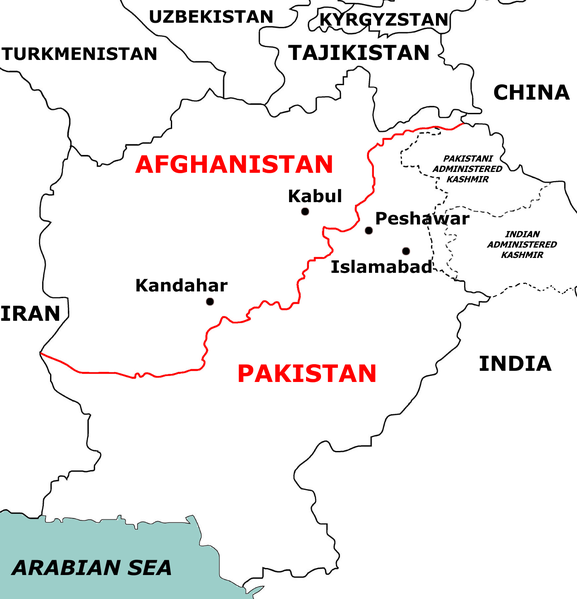
The Durand Line on the de facto Afghanistan-Pakistan border.
weaveravel, CC BY-SA 4.0More than a century later, it remains a deeply contested border. Since Abdur Rahman Khan, successive Afghan governments have refused to recognize the Durand Line as a permanent and legitimate international border, while Pakistan has insisted that it is its internationally recognized western boundary, inherited from British India. As a result, the Durand Line is a site of frequent outbursts of political friction, military skirmishes, and cross-border aggravation.
In border regions, state attention has historically been limited. Yet coercive fencing and security-driven policies on the Durand Line are being used as a political pressure tool, with border communities bearing the greatest burden. What are the reactions and lived experiences of border communities in response to the fencing project?
In 2024, the Kabul-based researcher Sabawoon Samim made a report for the Afghanistan Analysts Network, drawing on interviews with residents of the border provinces Khost, Paktia, Nangarhar, Kunar and Kandahar. The report The Durand Line and the Fence: How are communities managing with cross-border lives? examines the impact of the fence on people’s lives.
The sixteen residents interviewed told Samim that they see themselves as ‘one people, one culture, and one language.’ They describe the fence as something that has gone ‘through the heart’ of their society. Many believe Pakistan aims to permanently separate Pashtuns from each other to prevent quests for political or social unity that might challenge the border itself. They report that they are experiencing the erosion of a centuries-old cross-border identity.
Key border markets such as Chaman-Spin Boldak, Torkham, and Ghulam Khan cannot operate as before. Rural land owned by a myriad of Pashtun farmers lies on either side of the fence. Truck drivers and traders can no longer move goods freely, and the economy in places such as Landi Kotal and Parachinar has been badly curtailed. Smuggling across the border is a big part of people’s lives, and locals often have to pay bribes or take long detours even for the simplest of crossings.
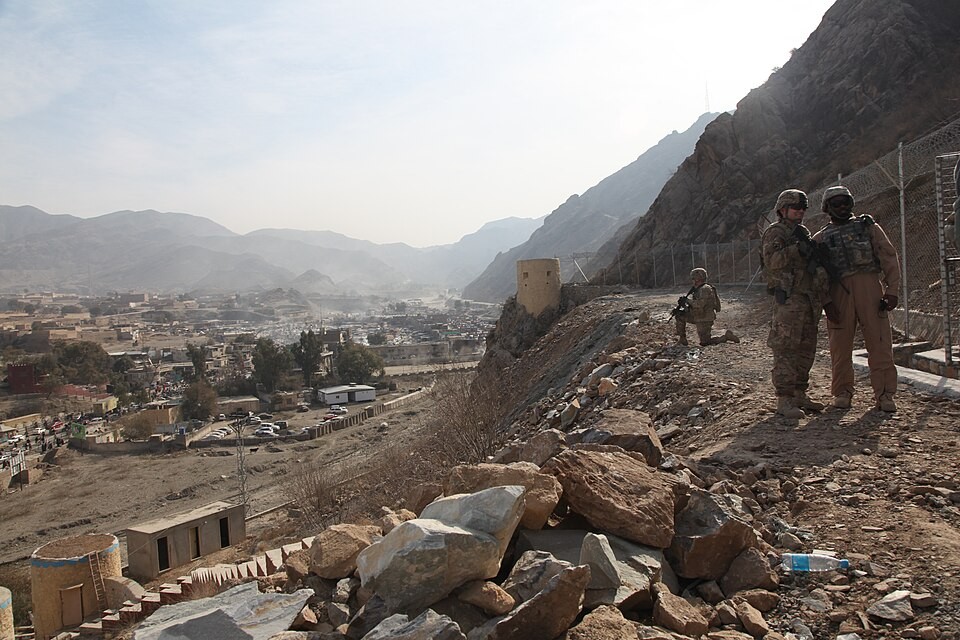
View from Torkham (Afghanistan) over the border to Torkham (Pakistan), 21 January 2013.
Spc. Ryan Hallgarth, Public domain, via Wikimedia CommonsEven worse, some locals are forced to send their children illegally across the border to earn a livelihood. ‘Such movement by young boys and girls is easier because they are less noticeable to border guards’, is how a report published by the Human Rights Commission of Pakistan titled, When Policy Divides: The Human Rights Fallout of Border Closures in Khyber Pakhtunkhwa and Balochistan puts it.
‘They can pose as family members of people allowed to cross the border and tow behind them. In some cases, they duck under a truck and cling on underneath it as it slowly drives across the border gate,’ the 2025 report says. This has exposed children to risks, including loss of life. Locals in the border region recall instances in which boys and girls crossing the border while hiding under a moving truck have tumbled, fallen and been run over.
Daily travel, once as ordinary as traveling to a provincial capital, has become dangerous, expensive, and time-consuming. Visiting family or accessing medical care now requires visas, permits, or informal payments. In mountainous and forested areas, the fence has even been built in disputed zones, extending into Afghan territory in parts of Khost and Spin Boldak.
In Spin Boldak, a schoolteacher in his forties from Nangarhar spoke with regret about the profound impact of the border fence on the social and tribal life of his community. ‘Before the fence was built, we moved freely to Bajaur, Mohmand and even Peshawar’, he is quoted in the Afghanistan Analysts Network report. ‘We attended weddings, funerals and other family ceremonies on both sides of the border, and people from the other side would come to ours as well. When disputes arose, we invited tribal elders from across the border to our jirgas and took part in theirs; we had a place and a voice in key tribal decisions. Many of the men in our village had married women from Bajaur, and many had given their daughters and sisters in marriage to men across the border. But now, we can no longer see each other as easily as before.’
Local communities describe the fence as harsh and unjust, often calling it ‘separating brother from brother.’ Many interviewees compared it to ‘losing a limb of the family.’ Widespread protests in Paktia, Paktika, and Kandahar in 2022, along with border clashes and even the destruction of parts of the fence by the Taliban in November that year, demonstrate the depth of anger and human suffering. The report argues that while the fence has not fully achieved Pakistan’s stated objectives, preventing cross-border attacks and illegal crossings, it has imposed heavy social and human costs on border communities.
Pakistan also uses the border and the expulsion of Afghans as a tool of political pressure, as the dispute over the Durand Line remains one of the key sources of tension between the two countries.
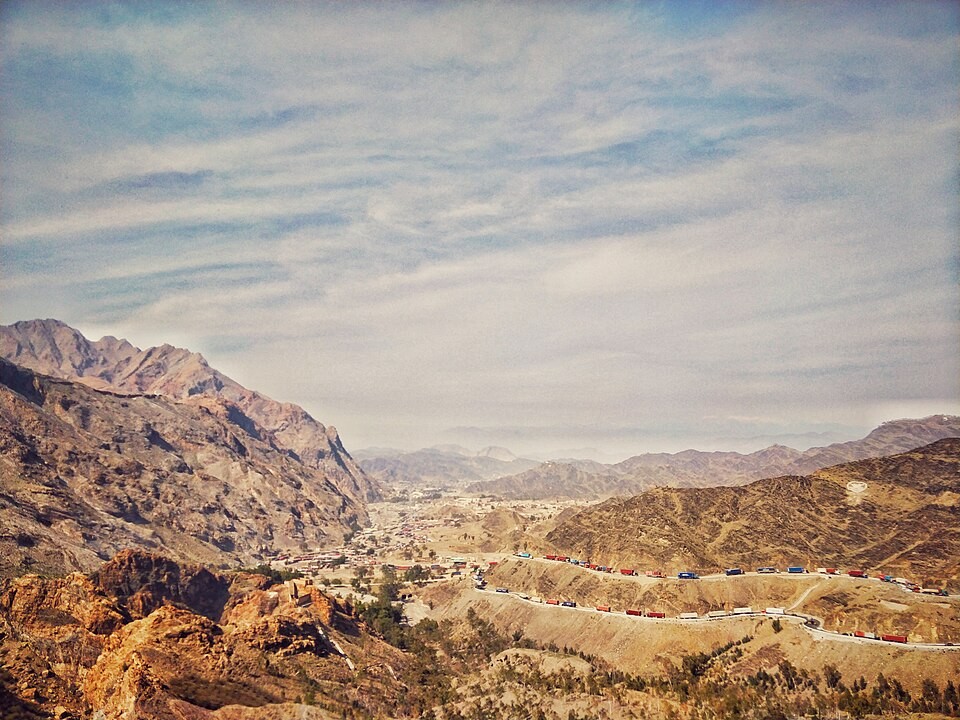
View from Michni Post to Torkham Border, Khyber Pakhtunkhwa, Pakistan.
Maximusopti, CC BY-SA 4.0In August 2025, Deutsche Welle reported that the sudden deportation of Afghan refugees by Pakistani police had put dozens of lives at risk. Those who had sought refuge in Pakistan to escape terrorism, repression, and violence now face the prospect of being returned to the rule of the Taliban.
Fatima, a 22-year-old medical student, told DW: ‘Two days ago we left our home in Quetta, and now we are heading to an unknown destination. I had to abandon my studies because I do not have the [newly] required documents. My dream was to work in a hospital, but now my future is entirely uncertain in a non-democratic country where girls’ education is banned.’
A final question remains: what can be done? The tribal institutions and shared histories used in resolving disputes in overlooked border communities offer useful starting points for reformers. Instead of viewing the borderlands just through the lens of security, policymakers should spend more time considering the kind of social, economic, and familial realities mentioned here.
The most humane approach would be to manage the region’s communities de facto, and find practical ways to protect family ties, access to healthcare, and legitimate economic exchange. A border policy that takes human realities seriously would be more stable and far more effective.