
“The Negligence Of Our Leaders Is Shameful”
- 24 November 2026
- Author Rasit Elibol
In Georgia, more and more land is being seized by Russian forces, who are pushing the disputed border of South Ossetia further into Georgian territory. Because Tbilisi does not want to offend Moscow, the situation is being monitored instead by civilians. “Look, there’s a land mine here.”
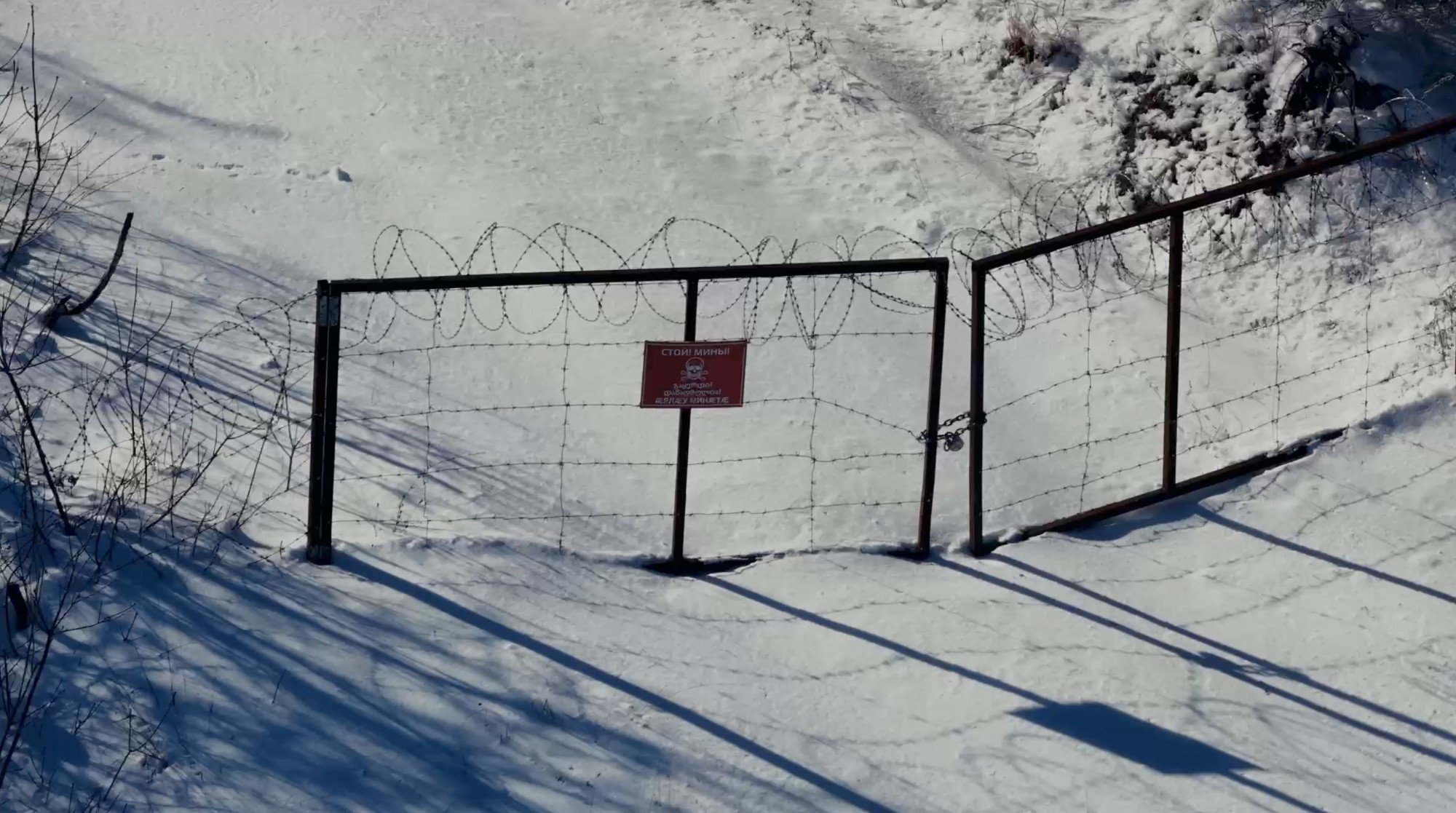
Drone image of the border fence between South Ossetia and Georgia. Stills from the Dutch TV program Rond de Zwarte Zee.
Dutch Angle TV Productions / VPRO“Don’t turn left here,” Dato tells the driver. “Because over there,” he points to the right, “there are officers who might come after us.” Once we’ve driven past and the police car is out of sight, he grabs his phone to warn a friend. “Did they turn you away? No? Very good.” We’ve already been stopped once by the police on the way, as we were driving out of the Georgian city of Gori toward the border area with South Ossetia. It’s not entirely clear why, but after a few minutes we are allowed to continue.
Then Dato’s phone rings. It’s his friend, driving ahead of us in another car to check for police checkpoints. “Is he following us?” It turns out the police aren’t following us, but Dato’s friend instead. “I told him: don’t turn off the road. Drive toward the Monastery of the Mother of God.”
We won’t see his friend again. He’s driving around the area to warn us in case there are police nearby. We, for our part, drive a little further north from Dirbi, to about five hundred meters from the line of occupation between Georgia and South Ossetia. This separatist region has been a Russian vassal state since the beginning of the war between Georgia and Russia in August 2008. Since then, Moscow has recognized South Ossetia as independent, and has stationed thousands of troops and a considerable amount of military equipment along its nearly 400-kilometer-long border.
On top of that, Russia regularly shifts the border, annexing more and more Georgian territory. It does this by erecting fences and barbed wire in the area and then moving them further into Georgian territory. But to avoid offending Russia, the Georgian government does nothing. Georgians who do want to take action are thwarted by their own authorities.
The authorities in question are “Georgian Dream”, the party that was re-elected in 2024 with the key message that Georgia must not offend the Russians. The country’s adult population remembers what happened in 2008, when Russia effectively occupied Georgia within a matter of days. A campaign video released around the 2024 elections depicted this in stark terms. It shows a split screen: on the right, a drone shot of a city in Ukraine that has been razed to the ground by bombs; on the left, a drone shot of a bustling city in Georgia. Accompanying the image is the question: “Don’t want this to happen in Georgia? Then vote for Georgian Dream.”
“Our government is getting in our way, supposedly to protect us, but that makes no sense,” says Dato. “If I were in danger near the occupied territory, it would mean they’re not protecting their citizens properly. If I’m not safe there, neither are the residents. The government pretends it’s doing this for the safety of its citizens, but that’s nonsense. They don’t want people to know what’s going on there. It’s ridiculous. I go there because I believe it’s essential for society to be informed about the occupied territory.”
That is why Dato tries not to make contact with anyone here in the village and draws as little attention to himself as possible. “I don’t know the people here. They could be police informants. That’s why I’m careful about who I talk to.”
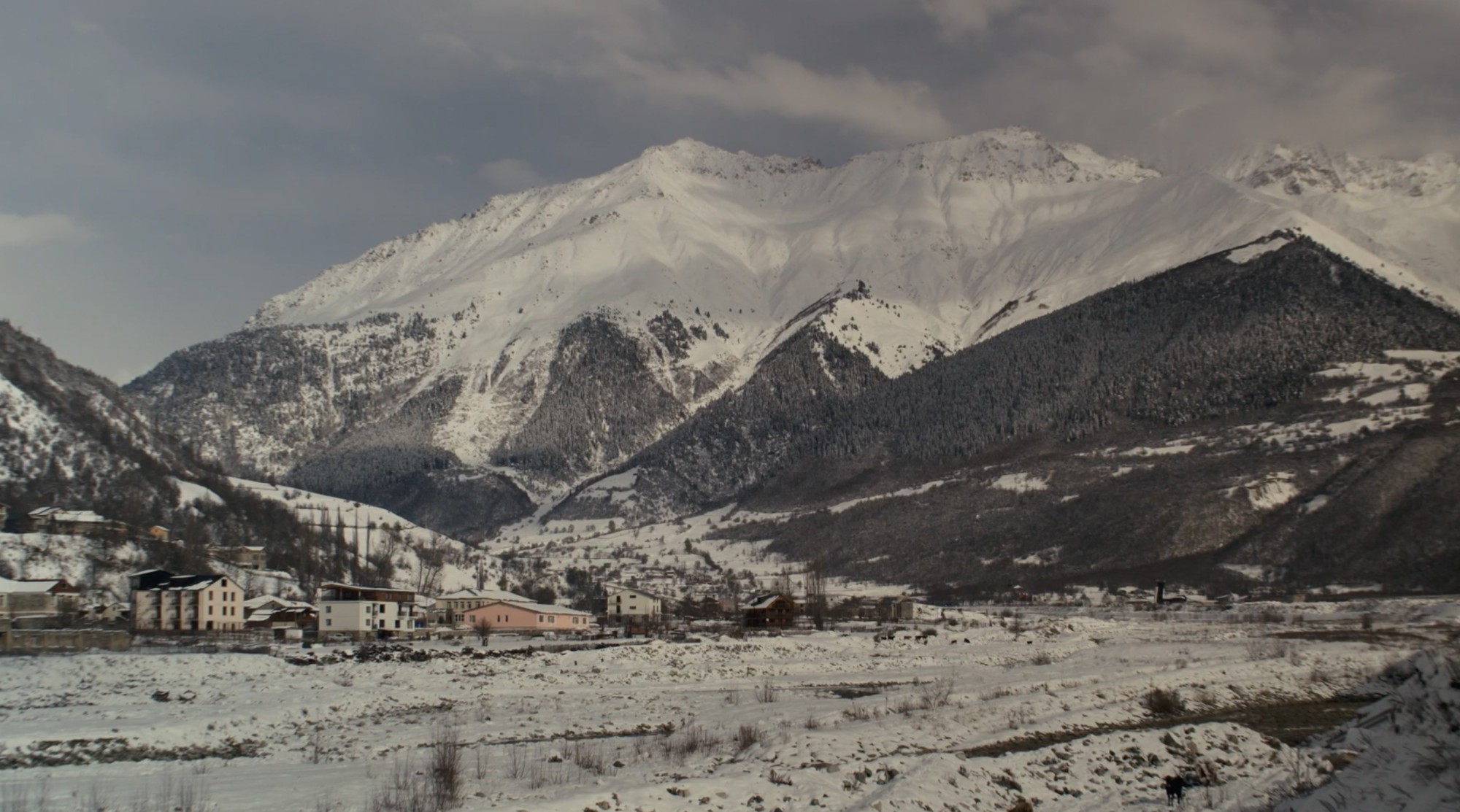
South Ossetia.
Dutch Angle TV Productions / VPRODato isn’t the real name of the man who wears a scarf pulled down just below his eyes and a hat pulled up just above them. “For my safety. There are local informants who tip off the police if I go to the occupied territory. Then I’m not allowed to take drone footage. That’s why I have to get there unnoticed. I don’t want people to recognize my face. If they know who I am, there’s a greater chance they’ll recognize me and call the police to tell them I’m there. That’s the only reason I remain anonymous.”
At the edge of the village, where there are no more houses, he takes his drone out of a case. The conditions aren’t great: it is snowing pretty hard and the wind is strong. We are standing 500 meters from the occupation line. “Look,” Dato says within a minute, pointing at the screen of the drone controller. “This is a Russian base on Georgian territory. There are FSB soldiers monitoring the occupation line.”
His screen shows a fairly complex facility. Since this isn’t his first time here— he tries to visit every area he monitors at least once a month—he can tell us exactly what we are seeing and that about a hundred Russian soldiers live here. “Look, all these apartment buildings—this is where the soldiers live. Here’s the meeting room. This is the training area for soldiers. This is the garage where they park their vehicles for patrols—the trucks and jeeps. No tanks, as far as I can tell. These are the dog kennels. Here are the water tanks. And in this small storage area, if I’m not mistaken, is the ammunition.”
Dato says he often plays a game of cat and mouse with the Russian soldiers. When they see his drone, they first hide so they can’t be clearly filmed and then alert their superiors. After that, they deploy anti-drone systems to take down his drone. There have also been several instances where they have tried to shoot his drone out of the sky with firearms. “They’ve never succeeded, but partly because of their anti-drone systems, I’ve already lost seven drones. It’s an expensive hobby, but it’s worth it.”
Why does Dato think the Russians are here? “First and foremost, they want to control the area. The second reason is to demonstrate their power to the local population. It’s like: look, we can set up bases here and intimidate you. Unfortunately, that works all too well. They want to show that they can do as they please without interference, because they really can. No one stands in their way.”
Dato is trying to document the daily life of the Russian border patrols. “What time they go out, what time they patrol, where they’re active, whether they’re digging trenches, putting up fences, or building guard posts. I want to gain insight into their daily lives. I then post that on my social media so that Georgians are informed about these abuses. But I also know that the authorities are watching and are therefore aware of it.”
Dato has over twenty thousand followers on social media. They don’t know his real identity. He remains incognito and doesn’t show his face. He knows that the government and police also watch his videos. They’re useful because they let the government know what’s going on. It’s technically Georgian territory, but it’s off-limits to the authorities. What happens inside remains unknown. Thanks to Dato’s footage, that information is available, and people can see what’s happening in the occupied territory. Then it’s time to move on. We can’t stay in one place for too long.
Over the past fifteen years, Russia and South Ossetia have demarcated more than sixty kilometers of the 390-kilometer-long border with physical barriers, such as barbed wire and fences, writes Gela Merabishvili. He is a Georgian political scientist who conducted research on this topic here last year and published the findings in Borderization in Georgia: A Mobility Perspective.
“Borderization” has radically transformed the Georgian villages along the border and created two forms of immobility within those villages, according to Merabishvili. First, parts of villages have ended up on the other side of the “de facto border.” At least 34 Georgian villages have been cut off from surrounding farmland, cemeteries, and churches. Between 800 and 1,000 families lost access to farmland, pastures, and forests that they previously used privately or as communal village property, according to figures from Amnesty International.
It seems so futile: thousands of Russian soldiers with advanced equipment pitted against a handful of well-meaning volunteers with drones. Why does Dato keep going? “Here’s our motivation: we refuse to accept the occupation. There are many people who don’t support us directly, but when the need arises, I’m certain they’ll stand by the country as well. I’m hopeful. There’s the younger generation. They’ll stand by us as soon as the country needs them. I help where I can, and everyone does so in their own way. Bakers bake bread, and we monitor the occupied territory. But there are more people who stand behind us and support us.”
Dato explains that every year in this area, between 100 and 150 residents from the surrounding villages are abducted by the Russians. “For various reasons. First, to instill fear among the local population, so that people stay away from certain areas as no one dares to go there anymore. This makes it easier for the Russians to occupy those areas. Second, it’s a way to make money. The abducted residents must pay up to 2,000 lari (680 euros—ed.) to the Russians to be released. This is how they supplement their budgets. Third, people are forced to confess that they crossed the national border. The aim is to have the occupation line recognized as the national border. Those are the three motives for kidnapping as many people as they possibly can. And all of this happens in unoccupied territory, because no one dares to enter occupied territory at all.”
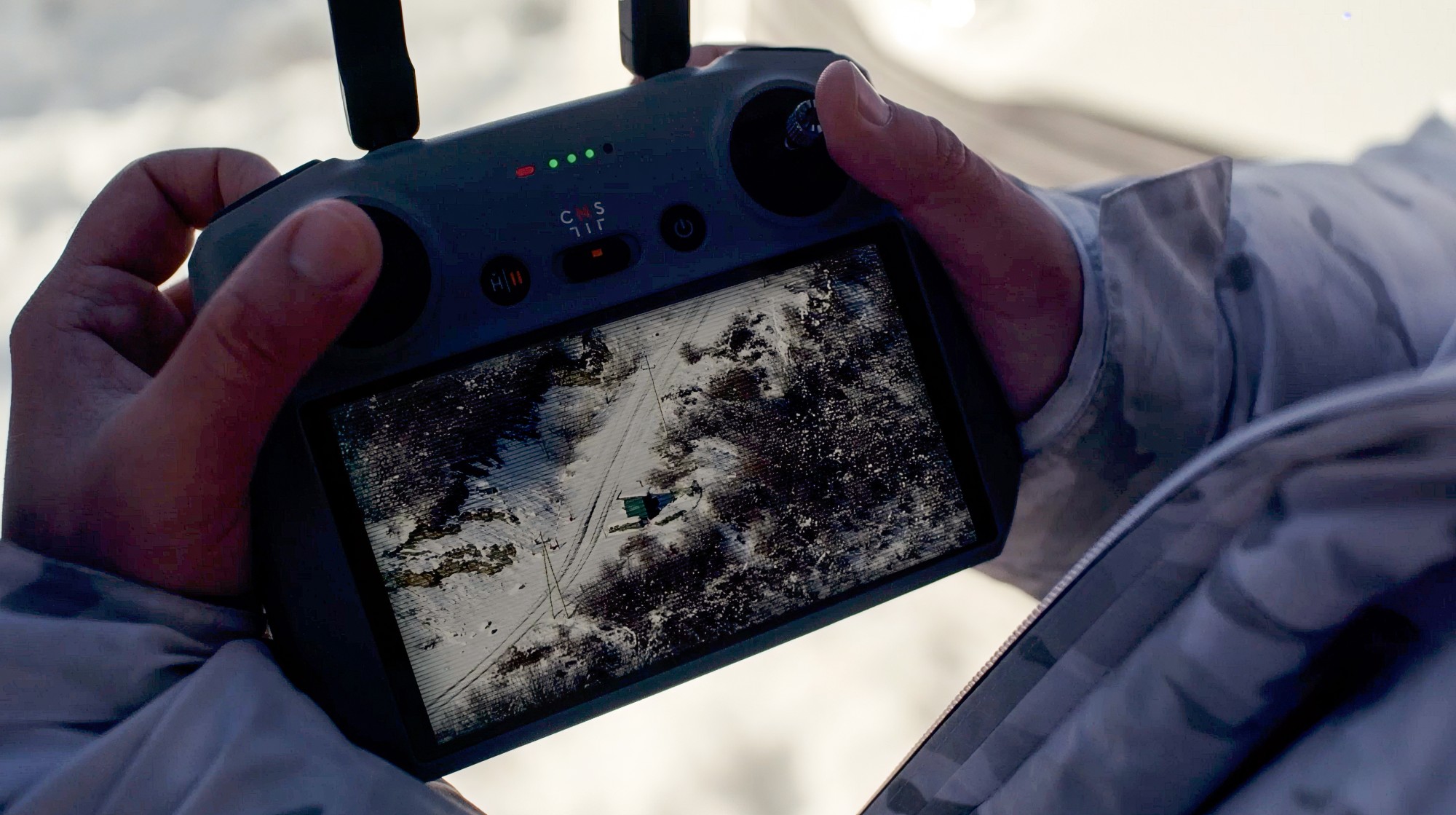
Dato with his drone.
Dutch Angle TV Productions / VPROThis is also reflected in Merabishvili’s research. He writes: “It is striking that the main obstacle to mobility and access to these places is not the physical fencing, but the Russian and South Ossetian border patrols. They regularly stop local residents who cross the border, regardless of whether it is physically demarcated or not. The lack of visible border barriers often leads to additional danger and uncertainty. Many residents tell stories of cows crossing the border and presenting their owners with a safety dilemma.”
For example, Merabishvili spoke with a woman who said she suddenly realized she had crossed the invisible border while following her cow. She could not catch the animal and bring it back to the Georgian side because she saw a border patrol nearby. So she left the cow behind and returned home. Otherwise, she might have ended up in a prison in Tskhinvali, where she would have been released a few days later—and only after paying a hefty fine.
Giorgi (not his real name) is a farmer from a nearby village. He rescheduled our meeting at his home at the last minute. At first, he cited the snow and the impassable roads as the reason, but then he admitted that he didn’t want any trouble. “It wouldn’t be the first time the police have made things difficult for us. Maybe they don’t want the situation to be brought to light.”
By “the situation,” he’s referring to what’s happening in his village and the surrounding villages. They lie right on the occupation line. That’s why we’re standing in a field, a few kilometers inland, with the snow-capped peaks of the Caucasus in the background.
Giorgi himself was abducted by the Russians, and during the 2008 war, his house was set on fire. “The Russian soldiers entered our village. It was around two o’clock in the afternoon. I was at home and stayed inside that day. They were armed; there was nothing I could do against them. I surrendered. The rest of the village had been herded to the church. They took me and two others to an abandoned police station. We were held there for two weeks.”
Giorgi is a tall, burly man in his fifties with a few days’ stubble. As he speaks, he frequently looks at the ground and shifts his foot back and forth in the snow. In a cell at the abandoned police station, Giorgi was given food and drink (“they didn’t starve us”), but he also received the occasional blow. “But I was still alive when I was released.” The joy of his release quickly faded when he arrived home: everything was gone—destroyed or burned. And, in fact, the area has never really been peaceful since then.
The current border between Georgia and South Ossetia dates back to 1922, according to political scientist Merabishvili. In that year, leaders in Moscow and the newly Sovietized Georgia established the South Ossetian Autonomous Oblast, a territorial administrative unit within Georgia. During the Soviet period, the border existed solely as a line on a map and had no significance in daily life or politics. “In the late 1980s, this line on the map took on concrete significance as interethnic tensions rose and later escalated into a territorial conflict in 1991 and 1992. The war claimed more than a thousand lives and forced many to flee. The violence politicized and intensified ethnic identity. As a result, many residents from ‘mixed’ families and people with multiple loyalties were forced to choose a side.”
The Georgian authorities abolished South Ossetia’s autonomy. This led the Ossetian administration and the region’s residents to declare independence from Georgia. The conflict resulted in a border that was both highly porous and geographically very complex, according to Merabishvili. He describes how, even within South Ossetia, there were several enclaves with an “ethnically Georgian” population surrounding the capital, Tskhinvali, which was under Ossetian control, and vice versa. After the collapse of the Soviet Union, the residents of the border region managed to navigate the challenges of the post-communist period by selling agricultural products to Russia. They were also able to make a living by importing cheap goods from Russia and reselling them elsewhere in Georgia. They similarly exported local agricultural products, mainly apples, to Russia.
“The border region around this market developed in the 1990s and early 2000s into a commercial and economic hub of national, if not Caucasus-wide, importance. But the Georgian government closed the market in 2004 as part of its efforts to reclaim the territory. The goal was to eliminate smuggling, enforce control over foreign trade, and, crucially, deprive the de facto government of South Ossetia of its main source of revenue. This would allow Georgia to expand its influence in the region,” according to Merabishvili.
As a result, local economic opportunities declined drastically in the years that followed. With the 2008 war and the subsequent fortification of the border, these opportunities eventually disappeared almost entirely. The central government addressed some of these social, economic, and infrastructural problems through tax breaks, subsidies, and the construction of new transportation and energy links between the border region and the central regions. As a result, the border strip—which had previously been closely intertwined with South Ossetia through trade, infrastructure, and family ties—became once again fully oriented toward the national capital, Tbilisi.
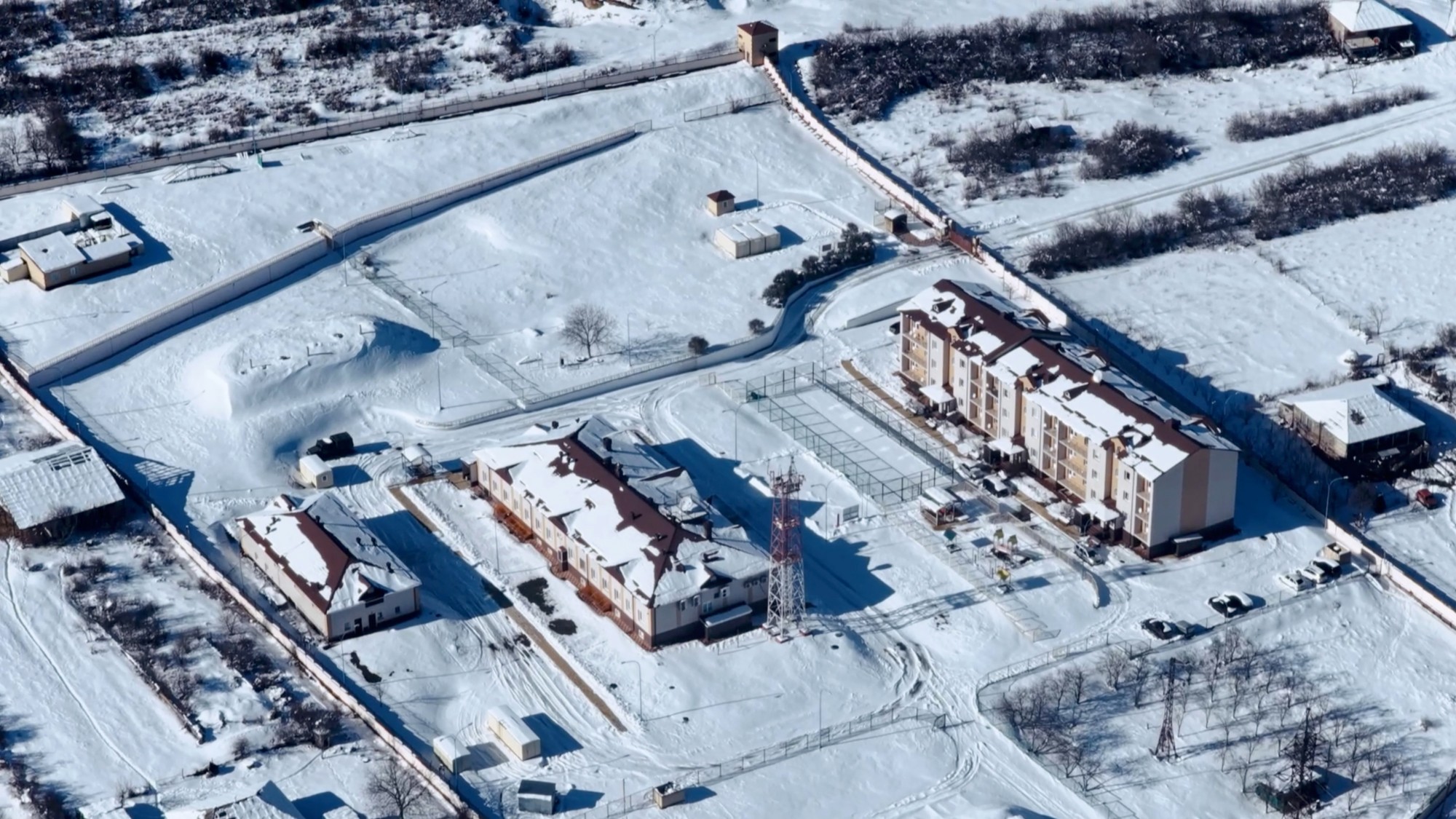
Russian military base on Georgian soil.
Dutch Angle TV Productions / VPROAfter his abductions and again more recently, Giorgi has often considered leaving his village. People are still regularly taken away by the Russians. “But where would I go?” Giorgi asks. “My family has lived in this village for generations, and like them, I’m a farmer. Working the land—that’s what we do. That’s what my family lived off of, and that’s what I live off of. I’ve never known any other work, and I have nowhere else to go. I was born and raised here, and I’m attached to this place. I’ve rebuilt my burned-down house as best I could. I work very hard to make something of it. Where would I go if I left?”
Without waiting for an answer, he continues. “If I had somewhere else to go, I’d consider it. Because conditions are tough. It’s not easy. We’re being oppressed. They’ve taken our land; we’re not allowed to approach the so-called border. We’re not allowed to be within 150 meters of it. They’ve rendered the so-called border meaningless. Anyone who approaches the border—even if it’s someone working the land—they don’t care if they’re farmers or shepherds: they’ll arrest you. People have been abducted from our village and neighboring villages. So we just do what we can. For me, there’s no other option but to stay here and be very careful.”
What does he think about the fact that his government isn’t doing anything to stop the abductions and land grabs by the Russians? “Our soldiers are being abducted, too. They’re pulling back, and we’re left behind. The Georgian police are here, but they’re powerless. People aren’t coming here anymore and have left their land behind. They’ve moved inland. The Russians can push the occupation line forward as they please. In places where there’s no barbed wire, the border has shifted further. That’s already happened twice in our village. The Russians hurt us and then want to be friends again.”
He pauses to think for a moment and sweeps some snow together with his shoe. “I don’t know either—that’s just how it goes in politics.”
Dato was also in this area two weeks ago, in a village about a twenty-minute drive from the previous one, where he took footage with his drone. “Do you hear that?” he asks. “I love the sound fresh snow makes when you walk on it for the first time.” He tries to visit each location once a month. “If anything changes, I want to know about it in time and take a look. So far, I’ve mapped out 55 villages right near the occupation line. They’re all in danger. Because the Russian soldiers are always active there, hunting people down to kidnap them. It’s very dangerous.”
“I don’t know what will happen to the residents if the Russians continue to occupy more and more land. Some may continue to live under occupation. Others will flee and go to Tbilisi to stay with family. We’ve had about 150,000 refugees from South Ossetia since 2008. This will create another wave of displaced people who will seek new shelter in the capital or other regions. And some will stay and live under the occupation because they have nowhere else to go. Those are the scenarios.”
Now we go to check out the checkpoints first and see if there’s anything new there. We’re also looking at the barbed wire and the signs. It’s striking that the fence is doubled up. One section is left over from the previous occupation; the second was installed when the Russians occupied new territories. Dato is going to film that, too. “There’s the river. This area is occupied, and now we’ll see the first checkpoints. This is a checkpoint, and this is barbed wire. This is the old occupation line. And here,” he says as he zooms out, “is the new one. A year ago, the occupation line shifted here.”
Dato doesn’t see any Russian soldiers right now. “It’s too cold for them,” he jokes. “Let’s take a closer look at this checkpoint. I want to film some videos of it. The army and the mines are so close by, but many Georgians are completely unaware. Because our government doesn’t talk about it, the majority of the population doesn’t know what’s happening here. They want people to see things through rose-coloured glasses. They lead them to believe that there is no occupation under their rule and that the Russians aren’t continuing the occupation. But in reality, the occupation continues. Under their administration, we’ve lost a lot of land. Unfortunately, they’re leading their voters to believe that they’re so tough they can stop the Russians.”
Then Dato says: “Look, a landmine. A kilometer away. They’re placing them there so no one will enter that area. It’s so frustrating that they come so close to us and can do as they please without hindrance. And our government is collaborating with them and doing nothing to stop the occupation. That’s how it seems, unfortunately. Some people claim they are doing something, but do they really mean it? Society doesn’t notice a thing. They’re not doing anything for the people.”
Dato is convinced that if the Russians hadn’t started a war with Ukraine and lost so many troops there, they would by now have many more soldiers in Georgia and would have seized even more land. “Look, in 2021 they held a meeting on the other side. They were discussing a new plan. Among other things, it was about what else they needed to take from us. This village was part of that new plan. They also wanted to split this village in two and take it over. That was in November 2021. But in 2022, the war in Ukraine began, and they received orders from Russia to put this plan on hold. Russia didn’t have the resources to continue occupying Georgia as well. That’s why they’ve temporarily suspended it, for as long as the war in Ukraine continues.”
What perhaps upsets Dato the most is that his own government is letting all of this happen. “What the Russians are doing is infuriating. But the negligence of our leaders is even more shameful, because they aren’t standing up for the country’s interests. The Russians feel at ease in our country. I don’t think we should make it easy for them. They shouldn’t feel at home here. We Georgians are hospitable—but to guests, not to enemies.”
This article previously appeared in the Dutch magazine De Groene Amsterdammer.
The Dutch TV program Rond de Zwarte Zee (VPRO), featuring Rasit Elibol and Jelle Brandt Corstius, is now on air on NPO2. The episode about Georgia and South Ossetia will be broadcasted on November 29.