

How Russia Is Rewriting Crimean History
- 12 November 2026
- Author Gabrielle McClellan
Since illegally annexing Crimea in 2014, the Russian Federation has extensively destroyed and excavated Ukrainian cultural sites. In Sevastopol, these efforts include the destruction of the ancient city of Tauric Chersonesos alongside the recruitment of Russians to work in the cultural sector, teaching revisionist history.
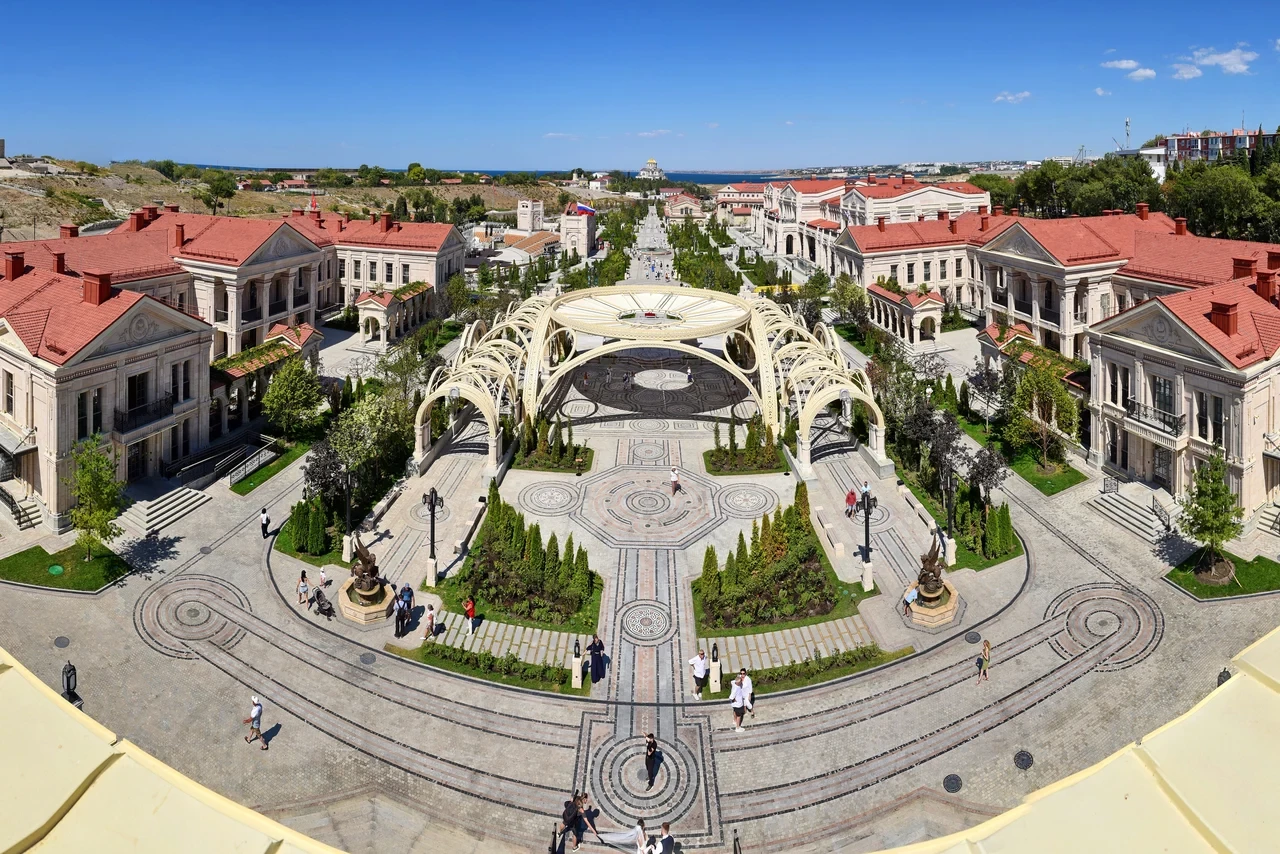
View from the observation deck of the Museum of Christianity. 2024
SretenskieM / Wikimedia Commons / CC BY-SA 4.0Donning a black baseball cap and a white T-shirt, Russian YouTuber Artem Lavrinenko welcomes viewers back to his Crimea Vlog. He holds a camera at arm’s length as he tours the Museum of Crimea and Novorossiya as part of his “Excursion through the New Chersonesos Archaeological Park,” gushing about his life days after its grand opening in the summer of 2024.
The 24-hectare New Chersonesos complex stands alongside the ancient city of Tauric Chersonesos, on Crimea’s southwestern Black Sea coast near Sevastopol. Ukrainian legal expert Daryna Pidhorna describes the new development as resembling “an amusement park,” built around the remains of a city founded by Greek colonists in the fifth century BCE.
Since Russia’s illegal annexation and occupation of Crimea in 2014, the site has been subjected to extensive destruction, construction, and transformation into a vast cultural and entertainment area, complete with museums, an opera and ballet theatre, an art school, and a hotel. Lavrinenko’s vlog presents these additions as evidence of investment and renewal. Ukrainian cultural heritage experts, however, see them as part of a broader effort to erase Ukrainian culture and assert Russian ownership over Crimea’s past.
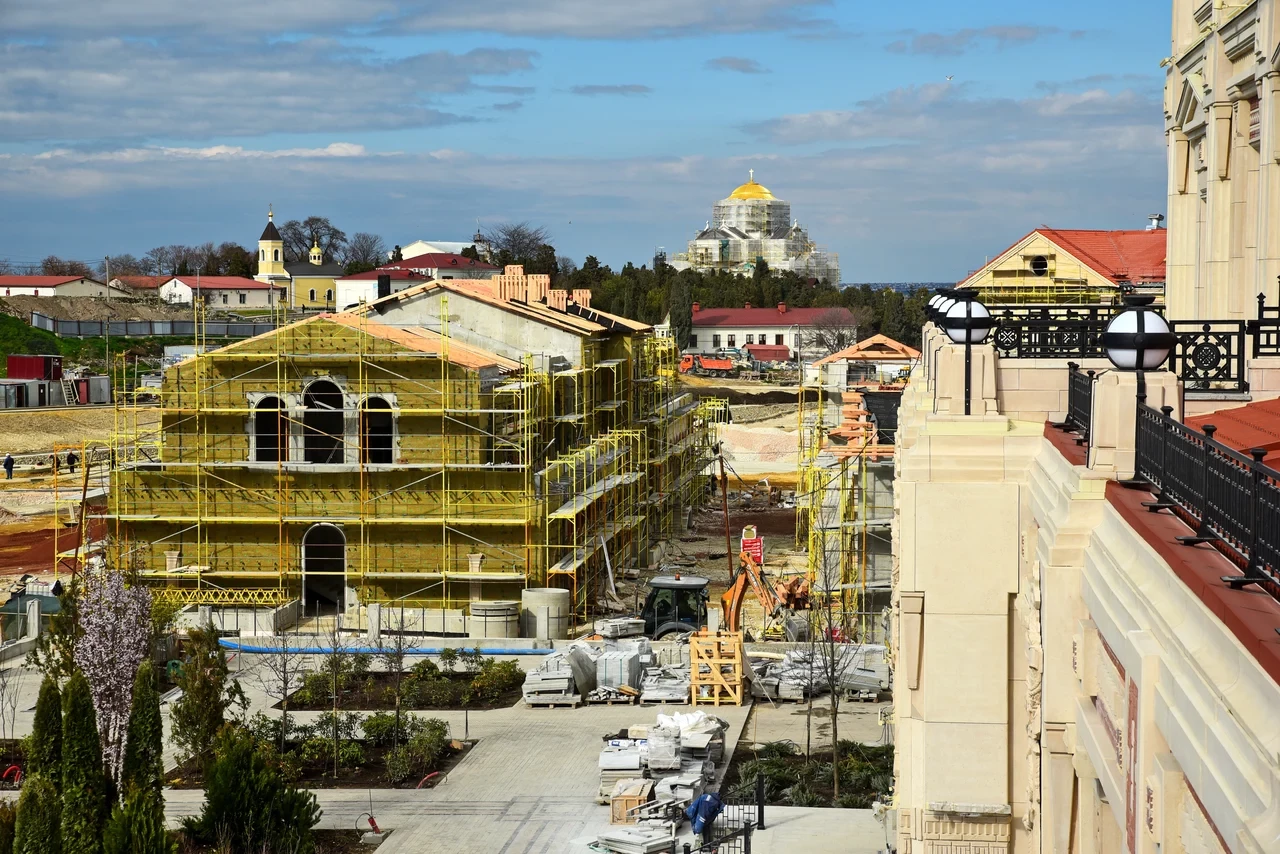
View from the balcony of the Museum of Christianity onto the construction site of New Chersonesos. Crimea, March 2024.
SretenskieM / Wikimedia Commons / CC BY-SA 4.0Founded as a Greek colonial settlement, Tauric Chersonese, the city that is now called New Chersonesos, later became part of the Roman and then Byzantine Empires. The ancient city’s archaeological remains comprise residential districts, defensive fortifications from the World Wars, and agricultural lands, known as the chora, plots of lands that segment the city.
The site’s importance extends beyond its archaeological remains. According to historical tradition, Prince Volodymyr of Kyiv was baptised at Chersonesos in 988, an event associated with the Christianisation of Kyivan Rus. In the nineteenth century, the Russian Empire began its excavations of the site, in search of a mythic “cradle of Orthodoxy,” as posited by the Ukrainian Institute. This legacy has given the place perpetual significance to cultural identity builders, Russian and Ukrainian.
UNESCO added the city of Chersonese to its World Heritage List in 2013, just before Russia invaded and illegally annexed Crimea. Soon after, Russia created a Ministry of Culture of the Republic of Crimea which has overseen the destruction and reconstruction of museums and cultural centers across the occupied peninsula. Beyond the extensive construction in Tauric Chersonesos, this project includes the destruction of the Khan’s Palace, a symbol of the Crimean Tatar state, and the destruction of third and fourth century “cave towns” of the Crimean Gothic tribes, or Gothia, according to the Kharkiv Human Rights Protection Group.
Vlogger Lavrinenko makes a feature of neat and tidy New Chersonesos, with its freshly built museums and year-old art school. The bright white facades and reddish-orange tiled roofs have been constructed in Byzantine-style, with columns, avenues, and manicured landscapes laid out in a pristine condition. Some of the buildings, like the three-year-old School of Arts in Sevastopol, are more Brutalist in style, with block-faced boldness absent the kind of Greco-Roman and Byzantine mimicry found elsewhere. The Russian Federation has also put efforts into reconstructing parts of Chersonese built more recently, such as the coastal batteries, Lavrinenko explains. He pans to one of the fortified defense structures built in the early 20th century. The entrances, he says, have been covered up.
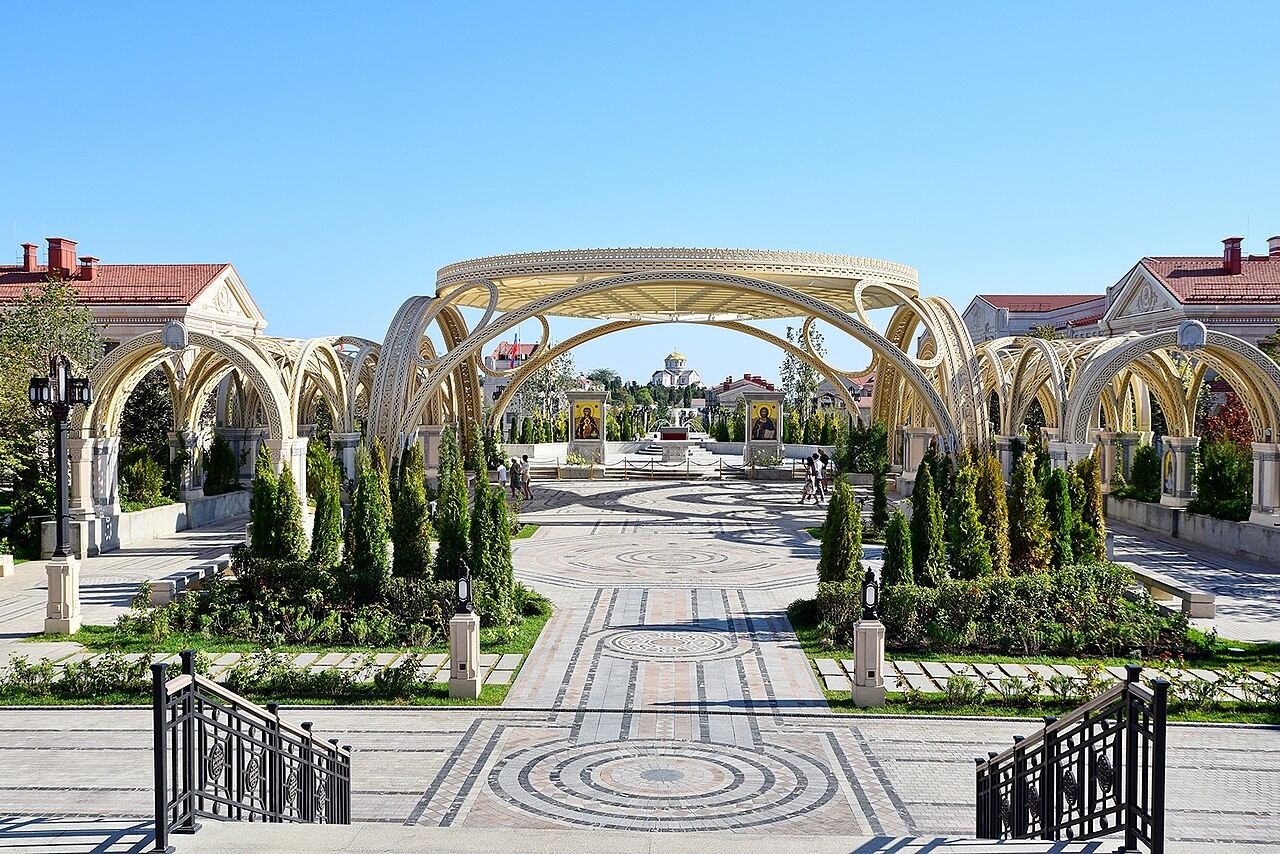
The Temple Park (Church of the Holy Trinity) in New Chersonesos.
SretenskieM / Wikimedia Commons / CC BY-SA 4.0In February of 2024, Russian President Vladimir Putin announced a brand new Zemsky Cultural Worker Program, in which librarians, museum staff, heads of amateur ensembles and instructors at village culture houses were to receive large incentives, budget housing, and cheap utilities if they moved to a settlement home to fewer than 50,000 people. This included the occupied territories.
The Zemsky Cultural Worker Program, open to applications from 2025, sanctioned the sponsored relocation of Russian citizens, primarily from central Russia, Moscow, Kaliningrad, Vladivostok, and St. Petersburg, to borderlands or occupied regions in exchange for a commitment to work in the relevant cultural sector. Those who were willing to move to the occupied Donetsk, Luhansk, Zaporizhzhia, or Kherson Oblasts were promised 2 million roubles (or about 22,300 euros). Those whose move was to Crimea would receive 1 million. Pidhorna, a legal consultant at the Raphael Lemkin Society, stated that the goal of the program was to promote a Russian nationalist narrative and monitor local populations for any signs of dissent, such as pro-Ukrainian sentiments.
In April of 2025, the Russian-installed governor of occupied Crimea, Mikhail Razvozhayev, announced the acceptance of applications for participation in the Zemsky Cultural Worker Program, as reported by Voice of Crimea. Open positions as of April 2025 include teachers and librarians, according to the Department of Culture of Sevastopol. Figures on the Zemsky Cultural Worker Programme, as compiled by the Lemkin Society, show 107 advertised posts across the five occupied regions in 2025, of which 71 had been filled. In 2026, 103 posts were listed. 24 had been filled by August, including 8 of 20 openings in the Crimean peninsula.
Participation in the Zemsky Cultural Worker Program is promoted like a selective competition or elite game, with participants urged to fulfill a range of criteria and apply during one of the annual competition cycles that take place each year. The program is modelled after the Zemsky Teacher and Zemsky Doctor schemes, which pay professionals who meet selection criteria to move to municipalities home to fewer than 50,000 people; the name recalls the zemstvos, the rural councils of imperial Russia.
The Cultural Worker Program is akin to imperialist culture initiatives, made tangible via policies and the Russian settlers themselves. In the Soviet empire, museums, theatres, cultural centers, and libraries were part of official networks developed around common narratives and ideas, designed to spread state propaganda to every city, village, and citizen. As Olha Sahaidak, chair of the Coalition for Cultural Actors, explains, “Libraries and exhibitions were formed to convey a shared ‘big history,’ including the victory of communist ideas.”
Under international law, it is prohibited for an occupying power to move its own civilian population into occupied territory, with the exception of security or military personnel needed to maintain minimum security. Pidhorna believes that the Zemsky Cultural Worker Program has a dual purpose: to ensure that cultural institutions conform to Russian Ministry of Culture narratives, and to monitor visitors and staff for anything conceived of as even remotely antagonistic. Any perceived dissent was to be reported back to the FSB.
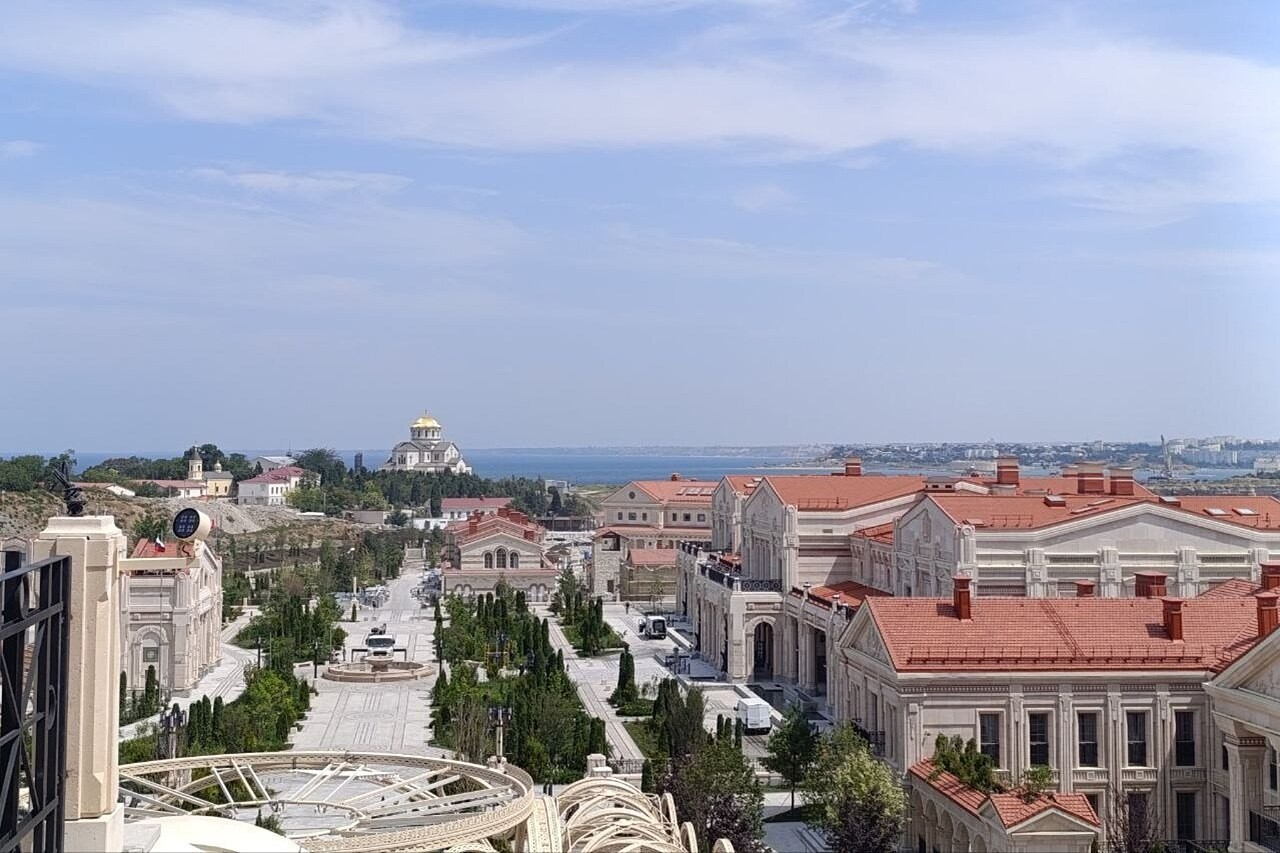
The New Chersonesos Museum Complex in Sevastopol, Crimea.
The Council of Ministers of the Republic of Crimea (under disputed Russian control) / Wikimedia Commons / CC BY 4.0Russian tourists visiting occupied Crimea are frustrated by inconveniences brought in by the Kremlin’s grand heritage-protection scheme. “We drove up, but the construction workers wouldn’t let us in!” writes Alexey from Moscow on TripAdvisor. He visited the state museum in Sevastopol in June of 2024, shortly before the grand opening. Bulldozers, temporary fencing, and unpaved dirt roads cut through white granite and limestone-lined boulevards on photographs uploaded to TripAdvisor. “They were in a rush to finish the ‘New Chersonesos’ project on time,” he remarks. “The main cathedral was cordoned off, and the whole area had been torn up, so we had to settle for watching archaeological excavations,” the Muscovite continues.
Russian vlogger Lavrinenko acknowledges the current poor state of the site resulting from ongoing construction. But he contrasts the site with the “complete wasteland” it was before construction began, insisting that now it is at least fresh and planned out, replete with green spaces and recently planted trees. Indeed, tourists bustle through the background of his vlog, lining up to enter the Museum of Christianity and sitting beside the Byzantine columns framing an outdoor café.
Cultural workers across Russia and the occupied oblasts of Ukraine are bound not just by Ministry of Culture decrees, but also by higher-level strategic documents, as Sahaidak explains. She says that this higher level includes a national culture strategy under the Russian Security Council and a national security strategy, both of which saying that anything inconsistent with the approved Russian historical narrative must be eliminated.
In Crimea, the Russian Federation “explicitly placed the cultural heritage sites located there within the categories of Russia’s heritage-protection system,” as Pidhorna explains in a presentation to the Raphael Lemkin Society, which means that Russia may move Ukrainian cultural objects under “pseudo-legal” claims that they are transferring heritage that is their “own.” Beneath all the talk of boosting cultural personnel, recruited workers are fundamentally implementers of national security strategy carried out via cultural institutions.
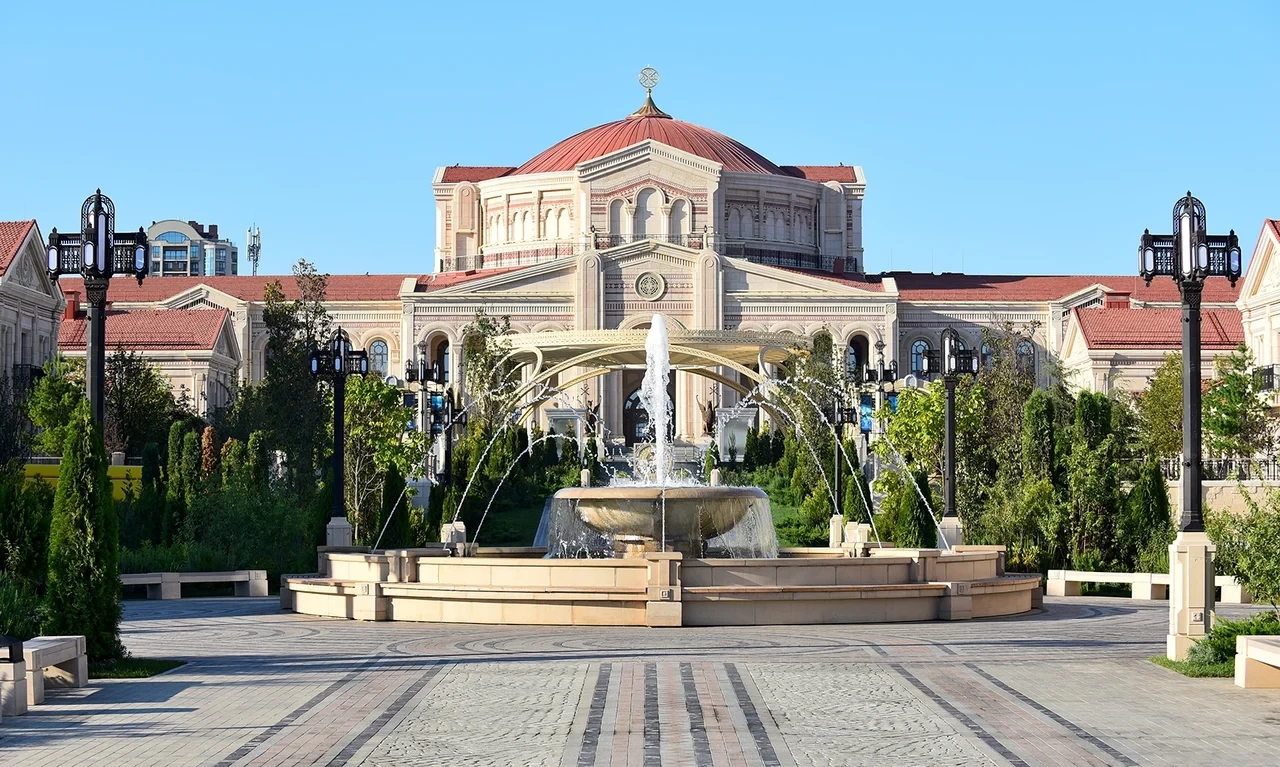
The Temple Park and the Museum of Christianity in New Chersonesos, Crimea.
SretenskieM / Wikimedia Commons / CC BY-SA 4.0A Russian-produced documentary on “New Chersonesos” claims that the city is the “sacred center of Russian statehood.” Hosted by Elena Morozova, who has been sanctioned by the EU for serious human rights violations and abuses, the film features interviews with President Vladimir Putin, and Archbishop Tykhon Shevkunov, the head of Russian Orthodox Church in Crimea. In his interview, Putin pronounces that Prince Volodymyr of the Kyivan Rus laid the “foundation” for the Russian state and Russian spiritualism, and that the New Chersonesos project is essential for “strengthening (…) the country’s future.” As the documentary progresses, the “strategic goal” of the construction in Tauric Chersonesos is made clear: “to revive the historical, cultural, and spiritual heritage of Chersonesos, to recreate a center of power in Crimea.” This goal echoes Russian imperialist efforts from 1827, when Chersonesos was declared the “cradle of Christian orthodoxy” to justify the site’s excavation.
Excavation of archeological sites has, for Russia, gone hand in hand with looting. Ukrainian cultural objects and sites have been ransacked. Alongside this archaeological destruction has come “mending” projects such as the Zemsky Cultural Worker program.
Shortly after the illegal annexation of Crimea in 2014, Ukrainian prosecutors began to receive large volumes of claims from Crimean residents regarding the violations of their rights to a cultural heritage. To Pidhorna, it became clear that Ukrainian legislation did not give the context of war and aggression enough weight when considering penalties for cultural destruction. A single article from the criminal code offered a maximum sentence of three years for the destruction of a cultural object, without any reference to the wartime context. “So,” she says, “we sought reform. I remember extensive debate over whether Ukraine should ratify the Second Protocol to the Hague Convention,” Pidhorna says. After much resistance, Ukraine ratified it in 2020. Incorporating it into national legislation remains an ongoing process.
As vlogger Artem Lavrinenko pans over New Chersonesos, he pauses. “Our beloved Crimea,” he says, followed by a pause. The view is of what he describes as one of the “most modern museums” in Russia. He walks the camera along an avenue overlooking the complex before pointing to the four flags at its heart: the flag of the Russian Empire, the flag of the Soviet Union, a Christian flag, and a “victory banner.”
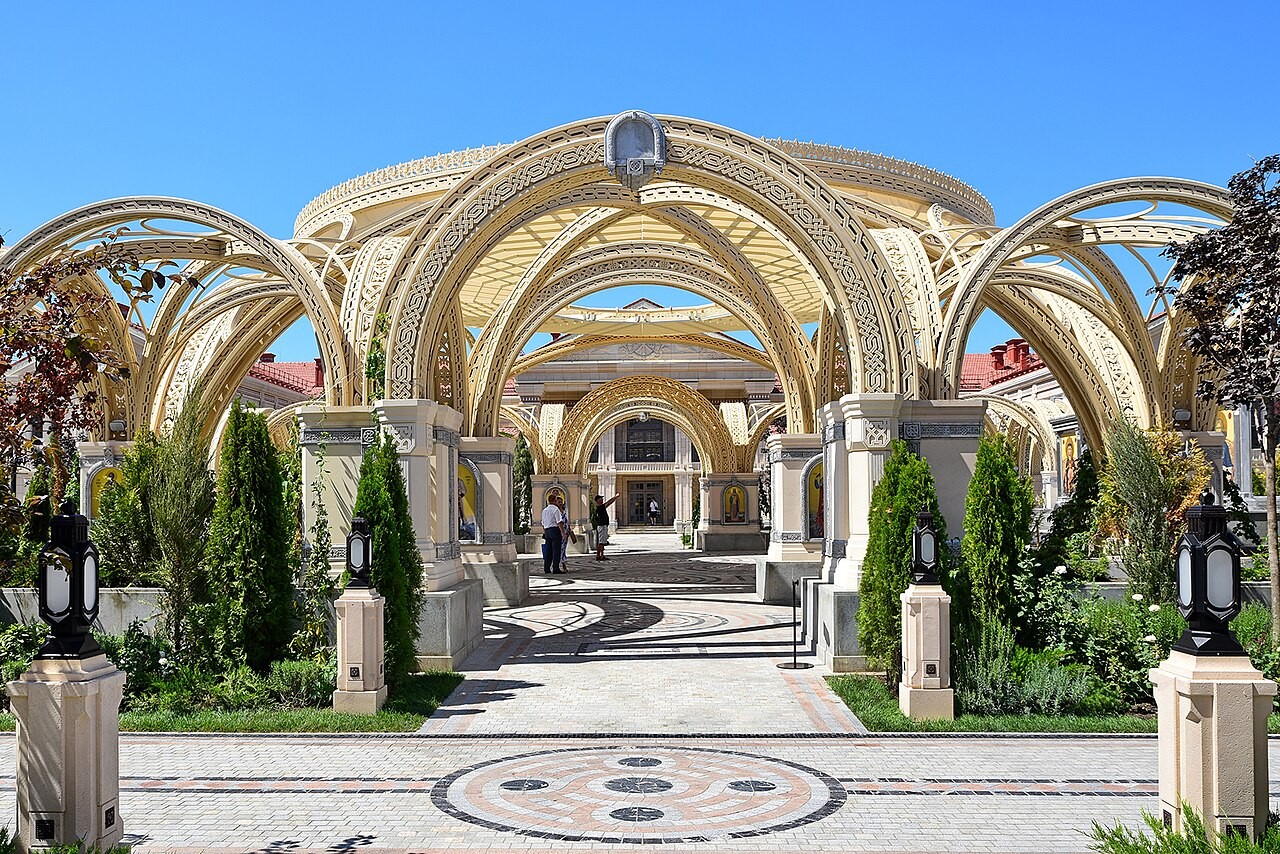
The Temple Park (Church of the Holy Trinity), part of the New Chersonesos complex.
SretenskieM / Wikimedia Commons / CC BY-SA 4.0