
An Inside View Of Kalakuta Republic
- 21 May 2026
- Author Leendert van der Valk
Much has been written about Fela Kuti’s music and activism, but seldom do we get such a vivid view behind the walls of his Kalakuta Republic as in the new podcast series, Fear No Man.

Promotion picture for the podcast 'Fela Kuti: Fear No Man'.
Higher Ground Audio and Audible OriginalsCircles. Spirals. Time. Music. These words keep repeating in episode 3 of the podcast series Fela Kuti: Fear No Man. Circles. Spirals. Time. Music. Combined with Fela Kuti’s famously trance-like afrobeat it has a hypnotizing effect on the listener.
With the music and circles spiraling, we enter a music club in Lagos on a night in the 1970s. We breathe air filled with cannabis smoke, we hear political conversations, we see the musicians – there seem to be dozens of them hanging around. Come to think about it, maybe everyone in here is a musician . This is The Shrine, the heart of the Kalakuta Republic, the self-declared independent state founded by Fela Kuti.
Its existence alone was a thorn in the side of Nigeria’s dictatorship. The Republic and the night club were raided and besieged by soldiers multiple times; who killed, wounded and raped its inhabitants. They arrested Kuti dozens of times; but each time he came back, even more determined, using music as his weapon.
Fela Anikulapo-Kuti has been the subject of many biographies. He was arguably the most influential African musician of the twentieth century and an absolutely fearless activist. But, even if you think you know his story, this thirteen-episodelong podcast series will keep you hooked. This is partly thanks to the excellent storytelling, but also the creators’ extensive research. The series, produced by Barack and Michelle Obama’s Higher Ground and narrated by Jad Abumrad (Radiolab), goes way beyond the music and gives plenty of background on the way Kalakuta Republic worked.

Album picture of Fela Kuti’s ‘Fear Not For Man’ (1977).
AfrodisiaThe episode ‘Enter the Shrine’ is key to understanding the mechanisms of this nightclub at the vanguard of musical innovation, where people like Paul McCartney and also members of James Brown’s band experienced club nights that changed their view of music. At the same time, the night club overlapped with the Republic, and functioned as a political asylum, a community house and a powerful source of political thinking and resistance. It was the place where Fela helped young kids to set up a newspaper, study African philosophers they didn’t study in school, and also planned his revolts.
But to tell the story of how and why Fela founded his own state within a state, the series also portrays Fela’s mother, Funmilayo. She was a fierce feminist who in 1948 shook the colonial powers by teaching market women to read and write, in order to demand fair taxes, and who led a march of 10,000 women to bring down a local ruler. She was also the first woman to drive a car in Nigeria.
Funmilayo Anikulapo-Kuti died in 1978, at the age of 77 after being thrown out of a window when the Kalakuta Republic compound, which consisted of the nightclub, houses, a recording facility and a health clinic, was raided by an estimated one thousand soldiers. She had been the inspiration for Fela Kuti’s pan-African activism and he never truly recovered from the loss. To make matters more complex, at first glance she does not seem to have been much of an inspiration for Fela’s attitude towards women. And this is where the story of Fela and Kalakuta becomes even more layered. In the same year of his mother’s death, Fela married the entire female entourage of his band, his so called ‘Queens’. He now had 27 wives.
Looking back on their lives, his Queens tell about how there was absolute equality inside Kalakuta. Some of them had fled their families and found a safe haven. Others mention how, to their relief, it was forbidden to talk about ethnicities. Unlike the outside world, inside the Republic there was no distinction between Yoruba, Fulani and Igbo.

A staged play in honour of the Women of the Kalakuta republic, the home to the king of Afro beats Fela Kuti.
Wikicommons, Ozor SamaniThe series sensitively touches upon subjects such as feminism, Fela’s denial of HIV/AIDS (of which he would die in 1997), and his religious fanaticism that he developed after his mother’s death. However, the podcast could have been more critical towards the complexities of the monolithic adoration of Fela. For example, the influential drummer Tony Allen, who co-invented the afrobeat sound and was one of the few musicians who, because he didn’t agree with some of the rules, opposed Fela, is not mentioned once in more than eight hours of audio.
Although Kalakuta was definitely a place of resistance and radical equality it was not necessarily a democratic republic. Fela offered his life for his music, and for his ideology of equality and Pan-Africanism, and expected the same from the people around him. Inside the walls of the republic there was not much opposition.
One of the last episodes focuses on his sons, Sean and Femi. Femi (the eldest) left the Republic with his mother at an early age, to have a safer childhood. At the age of 15 he decided to move back in with his father. Sean grew up within the barricaded walls and tells about how even he was treated no differently by his father than any other inhabitant. As a result, he felt like he never really had a father. He grew up listening to political conversations in a thick cloud of weed smoke, always fearing another raid by Nigerian soldiers. He often stayed at home from school, and worked in the band from a young age.
Both Femi and Sean have been successful afrobeat artists in their own rights for decades now. Listening to Sean and Femi’s music, it is clear how they have both adopted their father’s style. Femi takes a much more contemplative approach, while Sean has a forceful and more energetic sound. The circles and spirals of musical activism repeat in both their work. A lot of the problems that Fela addressed in his music are still present in Nigeria today, such as police violence and corruption. The compound of the Kalakuta Republic now houses a museum honoring Fela’s music and activism. It remains a place of resistance.
Fela Kuti: Fear No Man can be streamed on Spotify and all other podcast platforms. On Fela’s official YouTube channel, you can watch a series of songs, each featuring, alongside the music, an informative commentary by Afrobeat Historian, Chris May.
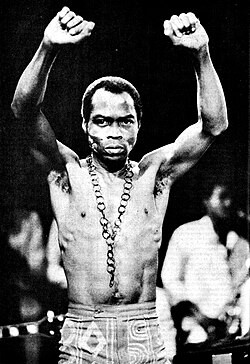
Fela Kuti photographed on stage. Distributed as a promotional photo in 1986.
Wikicommons